
Keep contamination out of fermentation without antibiotics or hop acids
Most ethanol plants already know what bacterial contamination costs: lost ethanol, extra cleaning cycles, sticky bacterial buildup, foaming, and time spent fighting infections instead of running the plant. Antibiotics, hop acids, and acid washes help only up to a point. They also add cost, residue concerns, and more cleaning.
There is a simpler approach. Add urea gradually as the only nitrogen source during fermentation and keep nickel levels extremely low. Yeast can still grow normally on the urea. The bacteria that cause most contamination need nickel to grow on urea; when nickel stays below a certain level, they cannot get established. Plants that use the method typically produce more ethanol, see less bacterial buildup, and spend less time and money on cleaning. The equipment needed is modest: usually a urea dosing system and confirmation that the heat exchangers use higher-grade (316L) stainless steel.
This is a simple modification to your plant. It’s easy to test and easy to revert to your existing process.
What the economics look like
On paper, a typical U.S. 100 MMGY corn plant can increase profits by about $12–16 million per year; a typical Brazilian sugarcane plant can increase profits by about $10 million per year. Those are modeled figures, not a guarantee. These figures depend on your current infection rate, enzyme program, oil recovery, and CIP procedures.
Using our technology for contamination control usually results in more ethanol, fewer infection events, less CIP chemical and downtime, and—on sugarcane plants—no acid wash, less gypsum fouling, and shorter cycles.
The main capital expenditure is the urea skid and, if needed, modifying plate heat exchangers to use 316L stainless steel plates (although this is what most plants already use).
Risk-free trial — no commitment
We offer potential customers the opportunity to try this in their plant without any commitment. We’re so sure that you’ll want to license this that we don’t ask for any money until you decide to license the technology.
You pay us nothing unless you decide you want to license the technology. Use your own criteria (for example ethanol yield, infection events, CIP time/chemicals, net margin after nitrogen-source cost versus a baseline, etc.). You may modify or replace these criteria at any time, and you do not need to give us any reason for your decision.
We pay for our costs to provide consulting to you; you pay for your costs to modify your plant (primarily a urea dosing skid; most plants implement with limited downtime).
We start with a Non-Disclosure Agreement (NDA) and technical discussions.
We then agree to a consulting agreement, patent license, and trade-secret license.
We then consult with you to help you implement the technology at your site for a mutually agreed test period.
If you decide you want to continue licensing this technology after the test period, we negotiate an annual license fee. We think a reasonable fee is about 10% of the projected increase in annual profits (you retain the large majority of the profits).
Either side may cancel this agreement and these licenses for any reason before an annual license fee is agreed; each party bears their own incurred costs. If the project ends without an annual license fee, you agree to return the plant to prior operating conditions.
What changes, and what does not
Typical changes:
Replace the usual nitrogen sources (ammonium, DAP, or nitrogen released by protease enzymes) with urea added in controlled stages.
Confirm 316L stainless steel plates are used in plate heat exchangers so nickel stays low.
With sugarcane ethanol, drop the sulfuric-acid yeast wash.
Reduce time spent on caustic and acidic Clean In Place (CIP).
Run a proven urea feed schedule and nickel/urea limits instead of inventing them on the fly.
Most existing corn ethanol and sugarcane ethanol plants can add this without major downtime.
Increasing Corn Ethanol Profits
Increasing Sugarcane Ethanol Profits
Increasing Nutritional Yeast Profits
Increasing Corn Ethanol Profits
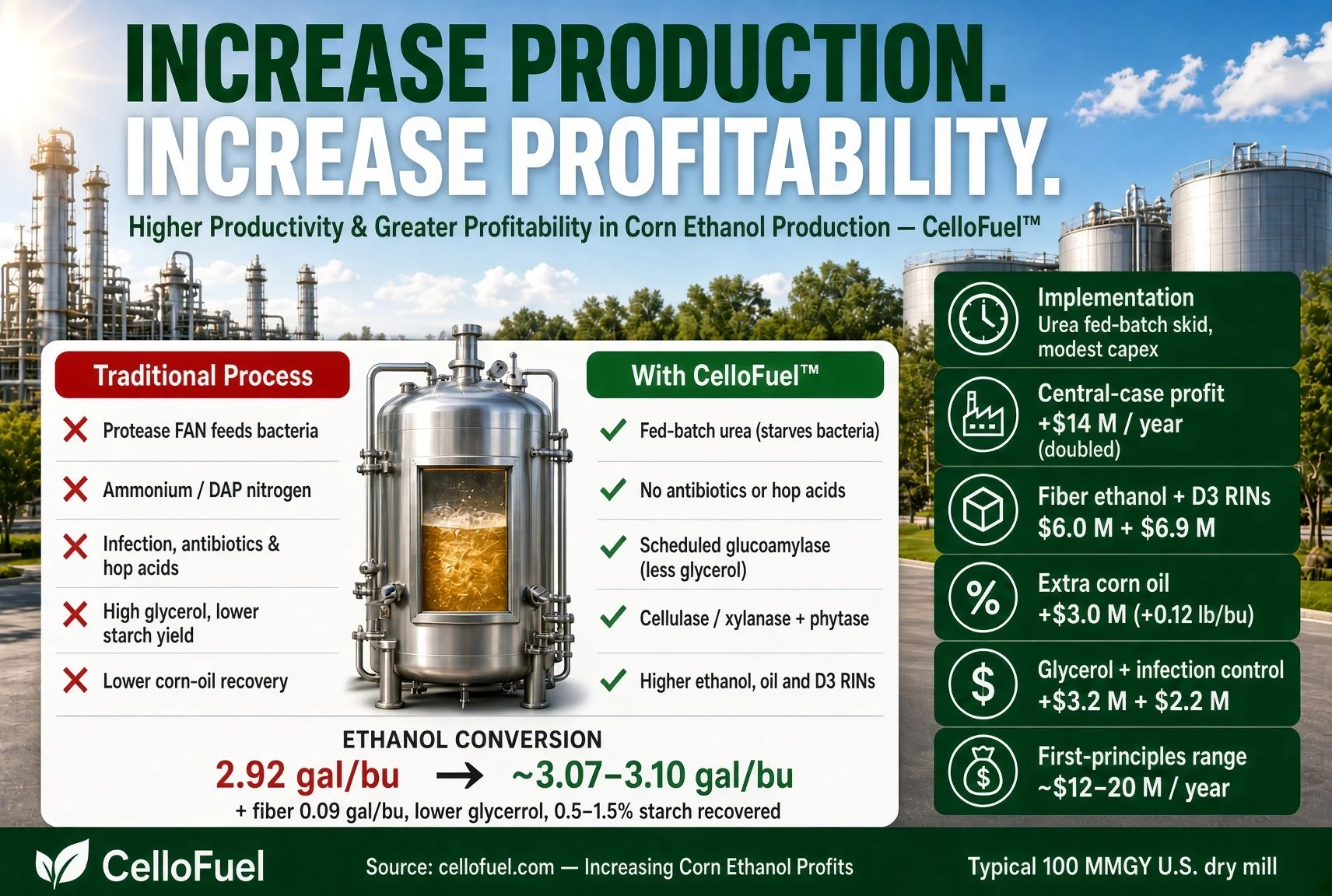
Our technology can be implemented at existing US corn ethanol plants with minimal process changes and modest capital expenditures (urea fed-batch skid). On average, the profitability of a typical US 100 MMGY corn ethanol plant can be increased by about $14M/year. See the profit breakdown in the next section.
By eliminating bacterial contamination using urea-based nitrogen control and by using enzymes strategically, plants can achieve higher yields, lower costs, and significantly reduced cleaning and maintenance — all without antibiotics or hop acids.
Changes to a typical existing process
If necessary, upgrade plate heat exchangers to use 316L stainless steel plates to eliminate nickel leaching (most plants already use 316L).
Eliminate the use of protease enzymes, which are expensive and produce Free Amino Nitrogen (FAN) that bacteria grow on during fermentation. About 90% of US corn ethanol plants currently use protease enzymes.
Eliminate the use of added calcium in fermenters by using newer alpha-amylases that don’t need added calcium, such as Liquozyme X/Supra, Termamyl SC, Spezyme ALPHA, Spezyme XTRA, Spezyme ETHYL, etc. These were specifically developed for much lower calcium dependence (often only 5–15 ppm, which is usually already present in corn and process water). This reduces the amount of acid Clean In Place (CIP).
Add cellulase/xylanase enzyme blends (OPTIMASH BOOST/AX or Novonesis Fiberex) to increase both ethanol and corn oil production.
Add phytase enzymes to improve yeast nutrition, reduce phytate-scale, reduce phytate-bound phosphorus in DDGS, and raise oil partition into thin stillage.
Let yeast grow on initial sugars and deplete FAN during filling and initial aerobic growth.
Replace all nitrogen supplementation during fermentation with fed-batch urea (no ammonium or DAP) to eliminate bacterial contamination and biofilm formation.
Use fed-batch feeding of glucoamylase enzyme on a predetermined schedule to reduce glycerol production and thus increase ethanol production.
Why this works
Bacteria need nickel as a cofactor to grow on urea during fermentation. Without it, they cannot multiply.
Yeast only needs biotin (vitamin B7) to use urea, so it grows normally.
This creates a natural advantage for the yeast while starving the bacteria, increasing the amount of ethanol produced due to less diversion of sugar to bacterial growth.
Glycerol is produced by yeast when high concentrations of glucose and maltose cause osmotic stress. We reduce this osmotic stress by introducing glucoamylase enzyme on a predetermined schedule, thus increasing the amount of ethanol produced due to less diversion of sugar to producing glycerol.
Reducing Clean In Place (CIP)
Three factors combine to reduce CIP: no bacterial contamination (infection), no added calcium, and phytase reducing phytic acid. Reducing the time and cost of CIP significantly increases plant profitability.
In corn dry-grind ethanol fermenters, the three conditions together reduce both caustic and acid CIP demand, with the larger relative drop in acid use. Caustic primarily removes organics, proteins, yeast residues, and biofilms; acid removes mineral scale (metal phytates, calcium/magnesium phosphates, beerstone/calcium oxalate, and mixed organic-inorganic deposits). The changes act on different soils and are synergistic because mixed deposits are common.
Typical practice is a hot caustic cycle (often 2–5% NaOH, sometimes targeting a 5–8% set point) after batches or on a short schedule, followed by an acid cycle (0.5–2% nitric, phosphoric, or blend) less frequently or when scale appears. Acid is often every few caustic cycles or as needed. Exact usage varies by plant water hardness, backset recycle, mash solids, and CIP program.
1) No bacterial contamination (no infection)
This mainly cuts caustic demand. Lactobacillus biofilms and associated organic slime/protein layers are a major reason for aggressive or extra caustic cycles; they also create hide-outs that require more thorough cleaning.
Without them:
Organic soil load on fermenter walls, cones, agitators, and associated coolers/headers drops.
Fewer infection-triggered extra CIP events or longer contact times occur.
Caustic concentration or cycle time/frequency is lowered.
Realistic reduction in fermenter caustic use is on the order of 20–40% (milder set points, shorter cycles, or extended intervals), consistent with optimized CIP programs that already claim ~25% caustic savings through better additives and control. Residual caustic is still needed for yeast and mash organics. Acid demand falls only modestly (less mixed organic-mineral soil and less pH-driven precipitation from lactic acid).
2) No added calcium
Corn and process water already supply some calcium; plants commonly add small amounts (e.g., CaCl2) to stabilize α-amylase and may recycle additional calcium via backset. Omitting supplements plus managing water hardness/recycle reduces available calcium for precipitation. This primarily cuts acid demand by lowering:
Calcium phytate scale
Calcium phosphate scale
Beerstone (calcium oxalate)
Caustic is affected less directly (some mixed deposits decrease). Combined with the other two factors, acid cycles become less frequent or lower-strength.
3) Phytase reducing phytic acid
Phytic acid (IP6) released from corn forms insoluble metal-phytate salts (especially magnesium and calcium phytates) that deposit as tenacious scale on fermenters and downstream equipment. Phytase hydrolyzes IP6 to soluble inorganic phosphate and inositol, converting the insoluble salts into removable soluble species and preventing new deposit formation. Phytate salts are the main fraction of “beerstone-like” deposits in beer columns and related equipment.
This is the strongest lever on acid CIP. With effective phytase dose and contact time (during liquefaction, SSF, or post-fermentation), phytate-related scale drops 70% or more (mirroring the reductions seen in DDGS phytate). Acid frequency, concentration, or duration therefore falls substantially — 40–70%+ for the fermenter acid step —because the main phytate-driven mineral soil is greatly reduced. Remaining acid use targets residual phosphates, oxalate, and passivation. Caustic sees a smaller secondary benefit from less mixed organic-inorganic fouling.
Combined effect on fermenter CIP
The three changes attack the two main soil classes at once:
No infection → less biofilm/organic load → lower caustic intensity.
No added calcium + phytase → far less phytate-metal and calcium-related mineral scale → lower acid intensity and frequency.
Expected outcome for corn ethanol fermenters (order-of-magnitude, plant-specific):
Caustic: 25–40% reduction in consumption or equivalent milder/less frequent use.
Acid: 40–70% reduction (largest single-factor gain from phytase).
Overall CIP chemicals, time, water, and downtime for fermenters: 30–50% reduction is possible, plus fewer hydroblasting events and better heat-transfer consistency.
Residual CIP is still required for non-phytate organics, residual minerals from corn/water, and routine sanitation. Benefits are largest in plants that currently see heavy phytate or mixed scale and chronic infection. Results depend on phytase dose/timing, residual water hardness, backset management, and CIP monitoring (titration of actual hydroxyl and conductivity). Optimized additive packages or pulse-dose methods already used in the industry amplify these savings further.
Corn Ethanol Profitability Analysis
The calculation below uses current industry averages (late-2025/2026 crush data, farmdoc conversion rates, USDA plant-gate prices, and published enzyme-trial results) and first-principles stoichiometry.
Plant basis
Nameplate 100 million gallons per year (MMGY) denatured ethanol.
Baseline conversion ≈ 2.92 gal/bu → ~34.25 million bushels processed per year.
Plant-gate ethanol ≈ $1.94/gal (Iowa FOB range early September 2026).
Distillers corn oil ≈ $0.74/lb.
D3 RIN ≈ $2.25 per cellulosic gallon (recent 2026 assessments ~$2.15–$2.41).
1. Extra ethanol + D3 from corn-kernel fiber
Cellulase/xylanase blends (OPTIMASH BOOST/AX or Fiberex) release glucose from pericarp and endosperm fiber. Commercial CKF data and EPA-accepted methods typically deliver 0.07–0.12 gal/bu incremental ethanol. Expected average for an unoptimized plant implementing only these enzymes: 0.09 gal/bu.
Extra volume = 3.08 million gal.
Ethanol revenue = 3.08 M × $1.94 = $6.0 million.
D3 credits = 3.08 M × $2.25 = $6.9 million.
(Phytase contributes little extra sugar but is required for the oil and yeast-nutrition effects below.)
2. Extra ethanol from lower glycerol
Fed-batch glucoamylase keeps glucose/maltose from spiking, cutting osmotic stress. Typical beer glycerol is 10–14 g/L; the process target is 5–10 g/L. A realistic 4 g/L reduction at 14.5–15.5 % v/v beer is equivalent to ~2 g/L extra ethanol (1 g glycerol ≈ 0.5 g ethanol on carbon + redox balance).
Extra volume ≈ 1.65 million gal.
Revenue = $3.2 million.
Urea versus ammonium/DAP independently lowers glycerol a further small amount; that increment is folded into the contamination-control line.
3. Extra corn oil
The same fiber-degrading enzymes plus phytase increase oil partition into thin stillage. Commercial trials of the named products show +15–30 % oil recovery; a plant that is already near the 2025 industry average (~0.93 lb/bu) can expect a +0.12 lb/bu incremental yield.
Extra oil = 4.11 million lb.
Revenue = 4.11 M × $0.74 = $3.0 million.
Offset from slightly lower DDGS weight is small because oil sells at roughly 8× the per-pound value of DDGS.
4. Contamination control, FAN management and nitrogen change
Eliminating protease-derived FAN, depleting residual FAN during fill, and feeding only low-nickel urea starves lactic-acid bacteria. Average plants lose 0.5–1.5 % of starch to infection plus spend $0.005–0.015/gal on antibiotics, hop acids or extra CIP. Combined yield recovery plus chemical/CIP savings: $2.2 million.
5. Net enzyme and minor opex
Protease elimination saves ~$0.8–1.2 million.
Incremental cellulase/xylanase + phytase cost (after the protease credit) is typically $1.6–2.2 million for this scale.
Phytase also reduces evaporator scale and phytate-P in DDGS (small maintenance and possible modest DDGS premium): +$0.4 million.
Net enzyme/opex drag: –$1.5 million.
Upgrading plate heat exchangers to use 316L stainless steel plates is one-time capex (most plants already use 316L) and do not affect annual profit.
Total expected annual profit increase
Fiber ethanol $6.0 million
D3 RINs $6.9 million
Glycerol-to-ethanol $3.2 million
Extra corn oil $3.0 million
Infection / FAN / urea $2.2 million
Scale / DDGS / CIP $0.4 million
Net extra enzymes -$1.5 million
Expected total ≈ $20 million
A more conservative set of assumptions (0.07 gal/bu fiber, +0.09 lb/bu oil, 3 g/L glycerol cut, $2.00 D3) still produces $13–15 million. Because many “average” plants already dose some fiber enzyme and already extract ~0.9 lb/bu oil, the realistic first-principles expectation for implementing only the listed steps is $12–16 million per year, with a central estimate of $14 million.
The dominant terms are the documented fiber-to-ethanol + D3 combination and the oil increment; glycerol reduction and infection control are secondary but additive and require no extra capital beyond dosing skids. Volatility in D3 prices (±$0.40) and oil prices (±$0.10/lb) can swing the total by ±$2.5 million in any given year.
Resulting range across the U.S. fleet
Plants with little protease elimination (90% of the U.S. fleet), little fiber-enzyme use, and conventional (non-fed-batch) glucoamylase addition: incremental profit near the $18–20 million first-principles total.
“Average” plants that already use some fiber enzyme and extract ~0.9 lb/bu oil (CelloFuel’s central case): $12–16 million, midpoint $14 million.
Plants that already combine fiber enzymes, high oil recovery, protease reduction or elimination, and fed-batch glucoamylase: incremental profit toward the lower end of the $10–13 million band (or the conservative $13–15 million case after smaller remaining steps).
Across ~191–198 operating U.S. plants (average capacity ~93 MMGY), the implied industry-wide incremental opportunity is therefore several billion dollars per year, but realized plant-level profitability will continue to vary with D3 RIN prices, oil prices, and how far each facility has already moved along the protease / fiber-enzyme / scheduled-glucoamylase continuum. The CelloFuel package is designed as a low-capex overlay (primarily a urea fed-batch skid) that can be added to existing dry mills with only modest process changes.
Increasing Sugarcane Ethanol Profits
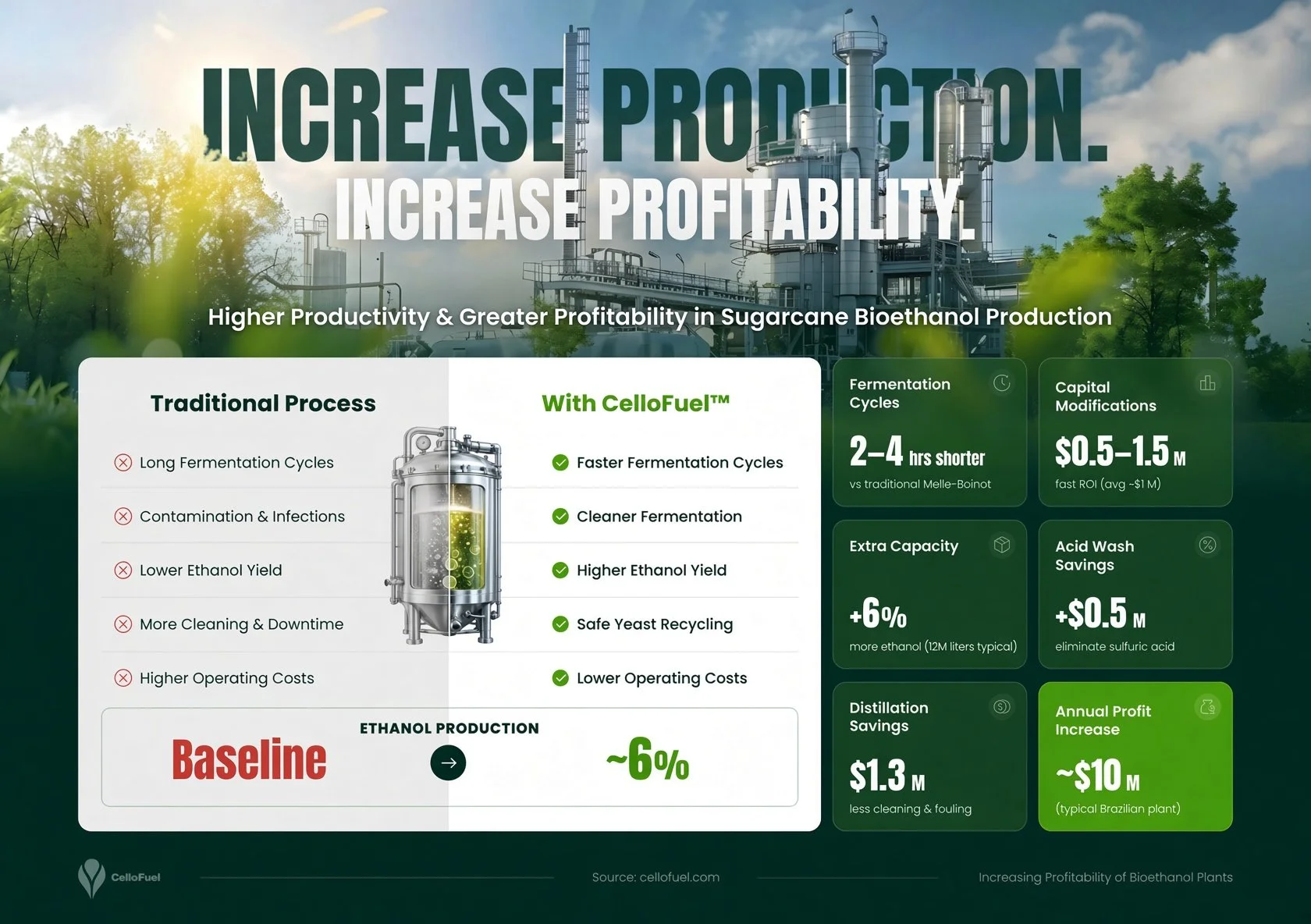
Our technology can be implemented at existing sugarcane ethanol plants with minimal process changes and modest capital expenditures (urea fed-batch skid). On average, the profitability of a typical Brazilian sugarcane ethanol plant can be increased by about $10M/year (i.e. about 50%).
We have developed practical technologies that improve both the efficiency and profitability of sugarcane ethanol plants in Brazil and India. The system controls bacterial contamination effectively without using antibiotics or the traditional Melle-Boinot sulfuric acid wash on recycled yeast.
How It Works
Instead of adding antibacterial chemicals to the fermenter or using sulfuric acid to kill bacteria during yeast recycling, we use a simple biological approach:
We switch the nitrogen source to urea (fed in batches).
We eliminate nickel leaching from the equipment.
Bacteria need nickel as a cofactor to grow on urea during fermentation. Without it, they cannot multiply. Yeast, however, only needs a small amount of biotin (vitamin B7) to use urea as a nitrogen source. This natural difference suppresses bacterial growth without chemicals.
Investment and Savings
For a typical large Brazilian sugarcane ethanol plant, the total capital cost of the modifications is approximately $0.5 – 1.5 million USD (average around $1 million). Most of this cost is for simple dosing systems for urea and activated silica.
The economic impact is very large. We estimate annual savings of about $10 million per plant.
Changes Required in Existing Plants
The following modifications are needed:
Replace current nitrogen supplements with urea and feed it in a controlled, fed-batch manner.
Use only 316L stainless steel plates in plate heat exchangers to prevent nickel from leaching into the process.
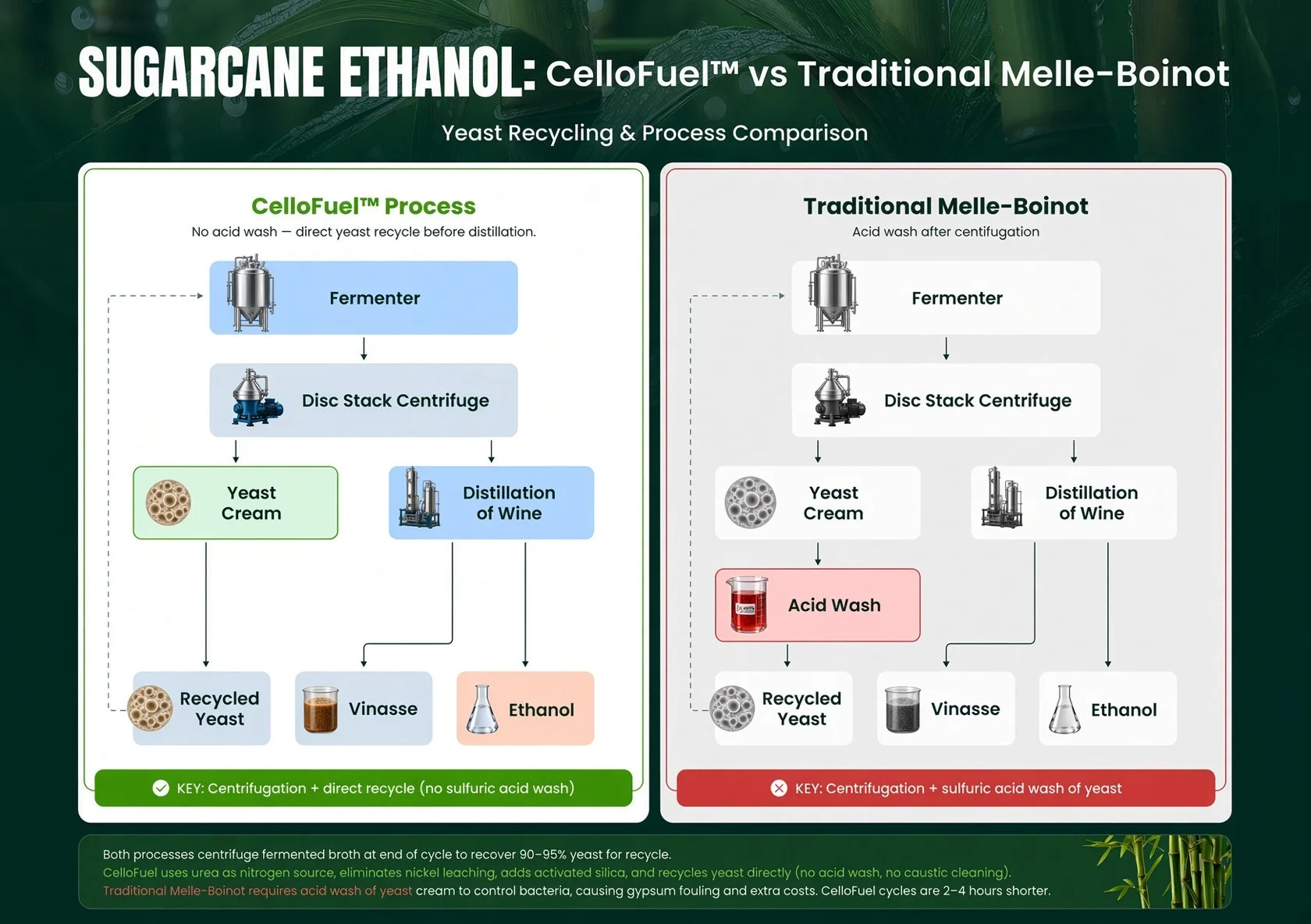
Use the existing centrifuge to recover yeast from the fermented mash (wine). This removes the need for genetically modified flocculating yeast.
Clean the fermenter between cycles using pressurized hot water instead of caustic chemicals.
Stop the sulfuric acid wash of recycled yeast — the yeast can be recycled directly back to the fermenter.
Eliminate the addition of calcium for neutralizing sulfuric acid and for clarifying molasses.
Eliminating sulfuric acid removes the need to clean gypsum/calcium sulfate buildup from the top of distillation columns.
Add activated silica (Brazilian technology) to maintain high yeast viability — above 80% even at 19% ethanol concentration. This also reduces glycerol production by up to 10% and increases ethanol production.
Results
These changes deliver fermentation cycles that are 2 to 4 hours shorter than the standard Melle-Boinot process. Because the system does not require sterile (aseptic) conditions, it is simpler, lower-cost, and significantly more productive than conventional methods.
Reducing Clean In Place (CIP)
A significant contributor to shortening fermentation cycles is reduced CIP. Three factors reduce CIP: no bacterial contamination, yeast recycling without sulfuric acid wash, and no added calcium.
1) No bacterial contamination
Biofilm and associated organic films become minimal. Caustic CIP frequency and intensity can fall sharply—often from weekly/as-needed chemical cycles toward infrequent water rinses plus occasional light caustic. Analogous improvements from better mechanical washing already reduce acid and antibiotic use while cutting contamination carry-over between batches. Combined with the other conditions, caustic consumption for fermenter CIP drops by 50–80%. Downtime and water/steam use also decline.
2) Yeast recycling without sulfuric acid wash
Sulfate carry-over into the fermenters is eliminated, so gypsum scale formation is eliminated. Acidic CIP demand falls. This effect is additive to the calcium reduction.
3) No added calcium
This is the largest lever for acidic CIP. Residual calcium in the must falls dramatically, so calcium oxalate, gypsum, and related scales form far more slowly or not at all. Acid CIP frequency can shift from regular (weekly or campaign-based) to rare or unnecessary; water or mild caustic may suffice for most cleaning. Parallel experience in sugar evaporators with reduced-calcium or dolomitic-lime clarification showed 40–60% less cleaning chemicals, ~50% shorter cleaning time, and 80–120% longer intervals between cleanings. Fermenters operate at lower temperature and without evaporative concentration, so the relative benefit should be at least as large (70–90% reduction in acid CIP chemicals is a reasonable expectation). Yeast performance may also improve slightly because high calcium is inhibitory.
Combined and secondary effects
The three conditions interact: less biofilm means less organic “glue” for mineral scale, and less mineral scale means fewer protected niches for microbes. Overall CIP chemical use (caustic + acid), water, energy for heating CIP solutions, and fermenter downtime falls by well over half. Plants still need occasional rinses and inspection, plus good mechanical coverage (rotating spray devices that reach roofs and shadowed areas). Residual soils from cane impurities or antifoam would remain, so CIP would not disappear entirely.
Quantification is plant-specific (juice vs. molasses ratio, water hardness, exact lime dose, fermenter geometry, current CIP schedule). Typical Brazilian practice already uses sulfuric acid mainly on the yeast cream rather than as fermenter CIP; the biggest incremental savings therefore come from eliminating lime-derived calcium and biofilms. Monitoring (conductivity, visual inspection, ATP or microbial counts, heat-transfer performance) would allow stretching intervals safely. Alternative clarification methods or calcium-minimizing juice treatment are required to realize the “no added calcium” case at industrial scale.
- Activated Silica: A special additive (from Brazilian technology) that helps keep yeast cells healthy and alive even when ethanol levels are high. It can also cut glycerol waste and boost ethanol output.
- Antibiotics: Medicines that kill or stop bacteria (this method avoids them entirely).
- Aseptic (Sterile) Conditions: A completely germ-free setup with no bacteria allowed (this simpler method does not require it).
- Bacterial Contamination: Unwanted bacteria getting into the fermentation tanks and competing with yeast or lowering ethanol production.
- Biotin (vitamin B7): A B vitamin that yeast needs in small amounts to grow well when using urea as its nitrogen source.
- Caustic Chemicals: Strong, harsh cleaners (like lye) traditionally used to scrub tanks (replaced here with hot water).
- Centrifuge: A spinning machine that separates solids (including yeast) from liquids in the process.
- Distillation Columns: Tall towers that purify ethanol by separating it from water and other liquids.
- Dosing Systems: Equipment that adds precise small amounts of materials (like urea) at the right times.
- Ethanol Concentration: The percentage of alcohol in the fermentation mixture (higher levels mean more product).
- Fermentation Cycles: Full rounds of turning sugarcane sugars into ethanol, harvesting, and repeating.
- Flocculating Yeast: Special yeast designed to clump together for easier separation (not needed with this method).
- Genetically Modified: Changed at the DNA level in a lab (this method avoids needing modified yeast).
- Glycerol: A thick/sticky byproduct that yeast naturally produces during fermentation. Reducing it allows more ethanol to be produced instead.
- Gypsum (Calcium Sulfate Buildup): Chalky deposits that can clog distillation equipment, often caused by acid use.
- Melle-Boinot Process: The common large-scale Brazilian method for producing sugarcane ethanol using fed-batch fermentation and yeast recycling, traditionally involving sulfuric acid dosing of recycled yeast to control bacteria.
- Nickel leaching: Nickel from metal equipment dissolving into the liquid (bacteria need it to grow on urea, so preventing this stops them).
- Nitrogen Source: The chemical providing nitrogen (a key building block for growth) to yeast or bacteria — switched here to urea.
- Plate Heat Exchangers: Devices with metal plates used to heat or cool process liquids efficiently.
- Pressurized Hot Water: Hot water sprayed under pressure to clean tanks without harsh chemicals.
- Recycled Yeast: Yeast saved from one fermentation batch and reused in the next.
- Stainless Steel 316L: High-quality metal used in equipment parts to prevent nickel from dissolving into the liquid.
- Sulfuric Acid Wash: Using strong acid to clean and disinfect recycled yeast (eliminated in this method).
- Urea: A common, inexpensive nitrogen source (also used in fertilizer) fed to yeast. It is added gradually with very low nickel to favor yeast growth over bacteria.
- Yeast viability: The percentage of yeast cells that remain alive and healthy. Higher viability improves recycling and performance, even at high ethanol levels.
Improvements with No Bacterial Contamination and No Yeast Washing
Now, let’s consider a modified process where no bacterial contamination occurs during fermentation, and no acid or water wash is applied to the centrifuged yeast. Instead, 95% of the yeast is recycled directly without washing. Here’s how this alters and potentially improves the process:
Operational Improvements
Elimination of Ethanol Recovery from Acid Wash:
In the standard process, acid washing the yeast can dilute any residual ethanol clinging to the yeast biomass. This ethanol must be recovered (e.g., via distillation), adding an energy-intensive step. By skipping the wash, no ethanol is lost to a wash solution, eliminating this recovery process and saving energy.
No Acid Neutralization:
Acid washing requires neutralizing the acidic yeast slurry (e.g., with a base like lime) before recycling to avoid harming the yeast or altering the fermentation pH. Skipping the wash eliminates the need for neutralization, reducing chemical inputs, waste treatment, and associated costs.
Simplified Process:
Removing the washing step streamlines operations by reducing the number of unit processes, lowering labor, equipment maintenance, and water usage.
These changes enhance plant efficiency by cutting energy, chemical, and operational expenses.
Equilibrium Concentration of Metabolites and Dead Cells
Without washing, the recycled yeast carries over fermentation metabolites (e.g., organic acids like acetic acid, glycerol, and higher alcohols) and weak or dead yeast cells into each new cycle. Here’s how this stabilizes:
Accumulation: Initially, the concentrations of these components increase with each cycle as 95% of the yeast, including its metabolites and dead cells, is reused.
Removal and Dilution:
5% Yeast Loss: The 5% of yeast not recycled (sold as animal feed) removes a small fraction of these components from the system.
Fresh Substrate Addition: Each cycle introduces fresh sugarcane juice or molasses, diluting the metabolite concentration in the fermentation broth.
Equilibrium: Over multiple cycles, an equilibrium concentration is reached where the rate of metabolite production and dead cell accumulation equals their removal (via the 5% yeast loss) and dilution (via fresh substrate). This equilibrium level is higher than in a washed-yeast system, where washing removes some metabolites and dead cells each cycle. However, since Saccharomyces cerevisiae is tolerant to many of its own byproducts (up to certain thresholds), and no bacterial competition exists, this higher concentration is manageable without significantly impairing fermentation efficiency.
Quantitatively, this equilibrium depends on fermentation conditions (e.g., sugar concentration, cycle duration), but qualitatively, it stabilizes at a level reflecting the balance of production, loss, and dilution.
Cycle Time Improvement with Water-Washed Vats
Finally, consider how not washing the yeast improves the overall cycle time when fermentation vats are cleaned with water instead of caustic:
Standard Cycle Time Components:
Fermentation: 6–12 hours.
Harvesting (centrifugation): ~1–2 hours.
Yeast Washing: In the standard process, acid or water washing, neutralization, and rinsing add 1–2 hours (depending on scale and method).
Vat Cleaning: Caustic cleaning, often heated and followed by rinsing, takes 2–3 hours or more.
Modified Process:
No Yeast Washing: Eliminating the washing step saves 1–2 hours per cycle. After centrifugation, the yeast is immediately recycled, cutting a significant preparation step.
Water-Washed Vats: Cleaning vats with water instead of caustic is faster—potentially reducing cleaning time to 1–2 hours—since it avoids heating, prolonged chemical exposure, and extensive rinsing. Water suffices here because bacterial contamination is absent, and the goal is simply to remove physical residues (yeast, sugars) rather than sanitize deeply.
Combined Effect: Without yeast washing, the time between fermentation cycles shrinks directly. Pairing this with quicker water-based vat cleaning further shortens the downtime, allowing cycles to restart sooner. For example, a cycle that took 12–15 hours (fermentation + harvesting + washing + caustic cleaning) drops to 10–12 hours, boosting throughput.
The absence of bacterial contamination enables these simplifications without risking fermentation performance, as bacteria—typically controlled by acid washing and caustic cleaning—are not a factor.
Conclusion
In Brazilian sugarcane ethanol production, the standard fed-batch fermentation cycle involves fermenting sugarcane juice or molasses with Saccharomyces cerevisiae, followed by centrifugation, yeast washing, and vat cleaning with caustic. When no bacterial contamination occurs and 95% of the centrifuged yeast is recycled without washing:
Plant operations improve by eliminating ethanol recovery and acid neutralization, saving energy, chemicals, and time.
Metabolite and dead cell concentrations reach a higher but stable equilibrium, balanced by yeast loss and substrate dilution, tolerable due to no bacterial interference.
Cycle time shortens by removing the yeast washing step (1–2 hours saved) and, when vats are water-washed instead of caustic-cleaned, further reducing cleaning time (1–2 hours vs. 2–3+ hours), enhancing overall efficiency.
This optimized process leverages the absence of contamination to simplify and accelerate ethanol production.
Reduces fermentation time:
In the improved process, fermentation time is reduced because the yeast is no longer subjected to the stress of acid washing. Here’s how this works:
Acid Washing in Traditional Processes
In traditional ethanol production, yeast is often recycled between fermentation cycles to maximize efficiency. To control bacterial contamination during this recycling, the yeast is washed with sulfuric acid. However, this acid exposure stresses the yeast cells. The stress can damage their cell membranes, lower their viability, and slow their metabolic activity. When these stressed yeast cells are reused, they need time to recover before they can ferment sugars efficiently. This recovery period, or lag phase, extends the overall fermentation time.
Eliminating Acid Washing in the Improved Process
In the improved process, the acid washing step is skipped entirely. After fermentation, 95% of the yeast is separated using centrifugation and directly reused in the next cycle without being exposed to acid. Since there’s no acid wash, the yeast avoids this stress. As a result:
Higher Viability: The yeast cells remain healthier, with intact membranes and better metabolic function.
No Recovery Time: Without the need to recover from acid stress, the yeast can start fermenting the new batch of sugarcane juice or molasses immediately.
How This Reduces Fermentation Time
The key to shorter fermentation time lies in the yeast’s improved condition:
Faster Start: In the traditional process, acid-washed yeast may enter a lag phase as it recovers from stress, delaying the start of active fermentation. In the improved process, this lag phase is minimized or eliminated because the yeast is unstressed and ready to work right away.
More Efficient Fermentation: Healthier yeast converts sugars into ethanol and carbon dioxide more quickly. Without the burden of repairing acid-induced damage, the yeast ferments at a faster rate, completing the cycle sooner.
How Much Time Is Saved?
The exact reduction in fermentation time depends on factors like the yeast strain, sugar concentration, and fermentation conditions. However, by avoiding acid stress, fermentation could be shortened by approximately 10–20%. For a typical 8–12 hour fermentation cycle, this might mean a savings of 1–2 hours per batch.
Additional Advantages
Beyond reducing fermentation time, skipping acid washing simplifies the process. It eliminates the need for acid, neutralizing agents, and extra steps like treating the wash, which also saves time and resources. With faster fermentation cycles, the plant can process more batches in the same timeframe, increasing overall productivity.
Conclusion
By eliminating acid washing, the improved process keeps the yeast healthier and more active, avoiding the stress that slows fermentation in the traditional method. This leads to a quicker start and more efficient sugar conversion, ultimately reducing the fermentation time while improving the process’s simplicity and efficiency.
- Acid Neutralization: Adding a base (like lime) to cancel out acid after washing yeast so it does not harm the next batch.
- Acid Wash: Treating recycled yeast with sulfuric acid to kill bacteria and clean it (this step is skipped here).
- Dead Yeast Cells: Yeast cells that have died during fermentation and would normally be removed by washing.
- Equilibrium Concentration: The stable level that waste products and dead cells reach after many cycles, where new production balances removal and dilution.
- Higher Alcohols: Byproduct alcohols made during fermentation that can build up if yeast is not washed.
- Metabolites: Substances (such as organic acids, glycerol, and alcohols) produced by yeast during fermentation.
- Organic Acids (e.g. Acetic Acid): Natural byproducts from fermentation that can affect the process if they build up too much.
- Water-Washed Vats: Cleaning fermentation tanks with just pressurized hot water instead of harsh chemicals (possible because bacteria are controlled).
- Yeast Washing: Cleaning recycled yeast with acid or water to remove contaminants and refresh it (eliminated here to save time, energy, and chemicals).
Brazilian Sugarcane Ethanol Profitability Analysis
This technique can be used in sugarcane ethanol plants in Brazil to improve efficiency, produce more ethanol, reduce foaming and reduce the strong odor from the vinasse. The changes using this contamination control technique enable using yeast recycling without acid washing to speed up fermentation time in flex plants.
Changes required: Minimal changes are needed to integrate our contamination control technique:
Use urea as the only nitrogen source, replacing ammonium sulfate
Use fed-batch feeding of urea
Make sure plate heat exchangers use 316L stainless steel plates (does not leach nickel)
Don’t use acid wash, recycle yeast cream directly from centrifuge
Clean vats with high pressure water spray, without caustic
Benefits:
Reduces wild yeast contamination: Without bacterial contamination, contamination by D. bruxellensis and other wild yeasts doesn’t occur when using a fast-growing S. cerevisiae strain like PE-2.
Reduces foaming: Foaming is reduced because the extracellular protein from Lactobacillus is eliminated.
Reduces strong odors: Eliminating sulfur from the wash and changing ammonium sulfate to urea results in significant reduction of sulfur in the vinasse, which reduces the strong odor from bacteria producing hydrogen sulfide from the vinasse. Not using sulfur dioxide in sugarcane juice clarification can further reduce the strong odor from the vinasse.
Reduces distillation column fouling: Eliminating the sulfuric acid wash eliminates adding soluble calcium sulfate to the distillation columns when recovering ethanol from this wash. Calcium sulfate from the wash also precipitates in the distillation column, causing fouling and requiring more cleaning.
Improves distillation efficiency: Sulfuric acid wash water dilutes the mash being distilled, which increases the energy and time needed for distillation. It’s more efficient to carry this ethanol with the recycled yeast into the next fermentation cycle.
Increases profits: The cost savings are considerable due to reducing the time per batch by 2-4 hours and improving process efficiency. The increase in income for a typical Brazilian sugarcane ethanol plant producing 6% more ethanol (12 million liters) due to eliminating bacterial contamination in fermenters is approximately $6,000,000 per year, assuming an ethanol price of $0.50 per liter. This figure could range from $3.6 million to $8.4 million depending on ethanol prices or plant size. The cost savings from eliminating the sulfuric acid wash is about $500,000 per year. The cost savings from eliminating calcium sulfate from the distillation columns is about $1.3 million per year. The cost savings from reducing the batch cycle time from 12-15 hours to 10-12 hours is about $1.3 million per year. The total cost savings are about $10,000,000 per year for a large sugarcane ethanol plant.
- Ammonium Sulfate: A chemical sometimes used to provide nitrogen to yeast (replaced here by urea).
- Calcium Sulfate: A mineral deposit (also called gypsum) that can foul distillation equipment when acid washes are used.
- D. bruxellensis (Dekkera bruxellensis): A type of wild yeast that can contaminate fermentations and reduce efficiency or quality.
- Extracellular Protein: Proteins released by contaminating bacteria (like Lactobacillus) that cause excessive foaming.
- Flex Plants: Ethanol plants with that can produce either sugar or ethanol, depending on which is more profitable.
- Foaming: Excessive bubble formation in tanks, often caused by bacterial proteins, leading to spills or operational issues.
- Hydrogen Sulfide: A gas with a rotten-egg smell produced by some bacteria from sulfur compounds.
- Lactobacillus: Common bacteria that contaminate ethanol production, compete with yeast, and create unwanted byproducts.
- Sulfur Compounds: Chemicals containing sulfur that can lead to bad odors in waste streams when bacteria are present.
- Vinasse: The watery waste liquid left after distilling ethanol; often used as fertilizer but can have strong odors from bacteria.
- Wild Yeasts: Any yeasts other than the desired Saccharomyces cerevisiae that can invade and lower production.
Increasing Nutritional Yeast Profits

We have developed technologies for expanding existing bioethanol plants to make affordable and healthy protein (TorulaFeed™) from rice, corn, and wheat and are developing technologies for expanding existing sugar beet plants to make TorulaFeed from sugar beet pulp.
There is a large market for healthy protein for animal feed and for human nutrition. The main countries for producing TorulaFeed from grain are the USA, China, Russia, and India because these countries have large amounts of low-cost grain, low-cost energy for steam, and low-cost urea. The main countries for producing TorulaFeed from sugar beet pulp are the EU, Russia and Turkey because these countries have large numbers of sugar beet plants that already store sugar beet pulp pellets and have existing infrastructure that’s unused in the off-season (steam generators, pelletizing equipment) that reduce the capital requirements for making TorulaFeed.
Torula yeast (Candida utilis) has been used for more than a century to feed fish, animals and people.
TorulaFeed is made from ground grain (rice, corn or wheat) and urea (for nitrogen in protein) using fermentation.
About 70% of the grain is starch, and this starch is hydrolyzed to sugar (maltose) using enzymes. This sugar is used to grow Torula yeast to make a 50% protein product (TorulaFeed) for fish, animals and people.
The valuable part of grain is the 10% protein it contains, and this protein is incorporated into TorulaFeed.
The less valuable parts of grain are fiber (arabinoxylan) and oils (Omega-6) and these are used along with sugar to grow the Torula yeast.
TorulaFeed is cost-competitive with soybean meal but much healthier.
Torula yeast can also be grown on the hydrolysis products of sugar beet pulp, which are mainly arabinose, galacturonic acid and cellulose. We use the same containerized rotating drum bioreactor that we use to make TorulaFeed from grain. The process is currently a trade secret.
The enabling patent for this invention has been granted in Russia and Brazil, is being examined in the USA, and is awaiting examination in China and India.
(CelloFuel™, TorulaFeed™, and TorulaBurger™ are trademarks of Hamrick Engineering.)
- Arabinoxylan: A type of fiber in grains that enzymes break down into sugars (xylose and arabinose) that the yeast can then use as food to grow and produce protein.
- Candida utilis: The scientific name for Torula yeast, a special microorganism used for over 100 years to make healthy protein for fish, animals, and people.
- Fermentation: The natural process where yeast eats sugars from grain and turns them into protein and other useful things.
- Hydrolyzed starch (or starch hydrolysis): Breaking down the main energy part of grain (starch) into simple sugars using enzymes so the yeast can eat them.
- Omega-6: Less desirable oils found in grains that the yeast uses along with other parts of the grain to grow and produce more protein.
- Protein incorporation: The way the natural protein already in the grain is mixed with the new protein made by the yeast to create a better final product.
- Single-cell protein (SCP): Protein made by growing tiny organisms like yeast instead of getting it from soy or animals.
- Starch: The biggest part of grain (about 70%) that is turned into sugar to feed the yeast during production.
- TorulaFeed: The brand name for the final high-protein (about 50%) product made from Torula yeast grown on grains.
- Torula yeast: A nutritious type of yeast specially grown on cheap grains to create affordable, healthy protein for feed or food.
TorulaFeed Technical Details
Overview
Recently, many companies in the plant-based meat replacement market have struggled with falling revenues. What’s causing these issues? The primary factors are nutritional controversies surrounding plant-based foods and their higher prices - they often cost significantly more than animal-based proteins.
Parallel to the plant-based meat replacement market is a much larger opportunity: protein sources for fish and animal feed that are healthier than soy meal. Yet soy meal remains the least expensive protein option in animal feed.
TorulaFeed addresses both markets. This innovative blend of Torula yeast and grain protein delivers high-quality nutrition at a lower cost. It's less expensive, more digestible, and more nutritious than soy meal or other plant- and animal-based proteins.
Yeast defies traditional categories: it's neither plant- nor animal-based, yet healthier than both, and suitable for fish, animals, and humans (including vegans). After all, most people consume yeast daily in bread. Not only is it nutritious and safe, but we've also solved its biggest hurdle - producing yeast protein more affordably than plant- or animal-based alternatives - through breakthroughs in cost-effective manufacturing.
Emerging research underscores why this matters: protein supports your health, while excessive carbs and seed oils (rich in omega-6 fatty acids) can harm your health. Grains like rice, corn, and wheat typically contain just 10% protein, alongside 70% carbs (mostly starch), 1–4% arabinoxylan (a type of fiber), and 0.5–3% omega-6 oils. Our proprietary technologies efficiently recover the protein from these grains while converting the less healthy components (starch, arabinoxylan, and omega-6 oils) into Torula yeast.
Potential Market Size for TorulaFeed Protein
TorulaFeed protein competes in the plant-based meat replacement market, valued at between $20-24 billion with a compounded annual growth rate (CAGR) of 7-9%.
TorulaFeed protein also competes in the animal feed protein ingredients market, valued at around $230-250 billion in 2023-2024 and projected to reach $410 billion by 2032 at a CAGR of 6-9%, fueled by animal feed and aquaculture expansion.
Specifically for aquaculture (a key target due to TorulaFeed's fish-friendly profile), the global aquafeed market stands at $67-72 billion in 2024-2025, expected to grow to $100-112 billion by 2030-2032 at a CAGR of 4-7.5%.
Balanced protein
Protein is more valuable when the constituent amino acids are a balanced source of food for fish, animals, and people. Rice, corn, wheat and bran protein is deficient in lysine and rich in methionine while yeast protein is rich in lysine and deficient in methionine. A mixture of these two types of protein is therefore more balanced (and thus more valuable) than rice, corn, wheat and bran protein alone. This balance is the reason for the modern trend of vegan meals made from seitan (vital wheat gluten) mixed with nutritional yeast.
Improved healthiness
Our mission is to produce TorulaFeed that is less expensive and healthier than protein from legumes such as soybeans, peas, and faba beans. These legumes contain many anti-nutritional factors (ANFs) that make them less than ideal for animal feed and human nutrition. These include trypsin inhibitors, lectins, oligosaccharides, phytic acid, saponins, antigens, isoflavones, tannins - all of which are harmful in feed. Carnivorous fish (salmonids/shrimp) suffer enteritis/growth issues at more than 30% soy. Young animals (piglets/chicks/calves) face digestive problems; poultry suffer from diarrhea and reduced growth. TorulaFeed has no ANFs, yielding healthier fish/chicken/pigs and healthier plant-based protein for people.
Reducing cost
The high cost of producing yeast protein compared to soybean protein is one of the main reasons it hasn’t previously been used as a replacement for soybean protein, so we’ve focused on patented technologies to make low-cost production possible.
Our process reduces capital expenses (CAPEX) and operating expenses (OPEX). We use enzymes to convert the starch and xylan in ground rice, corn, wheat and bran into maltose, xylose, and arabinose while simultaneously growing Torula yeast (Candida utilis) on these sugars in a rotating drum bioreactor (RDB). Air blown through the drum enables evaporative cooling, and we add water to maintain moisture without excess wetness. We harvest partial yeast batches, recycling the remainder along with enzymes to speed up subsequent cycles.
Depending on the country, rice, corn, wheat and bran are the least expensive sources of starch-derived sugars, yielding not just single-cell protein (SCP) but also converting oil to protein and incorporating the grain's protein, potassium, and phosphorus into the feed.
System design
Our portable design fits in 40-ft high-cube shipping containers, using spiral-wound High-Density Polyethylene (HDPE) rolling drums that are 2.0 m inner diameter, and 10 m long. These drums are made from food-grade HDPE, are 1/10 the price of stainless steel 316L and don’t leach nickel. These containers are factory-assembled, transportable by truck/train, and support rapid large-scale setup.
Capacity and cost of production
The rolling drum has a volume of 31.4 m3. It can be filled to 1/3 of this volume, which can hold 3.02 metric tons (MT) of ground grain and 6.05 MT of water. The rolling drum produces about 1.96 MT of TorulaFeed in a 48 hour cycle. A single container processes 552 MT/y of grain and produces 357 MT/y of TorulaFeed.
A site with 100 containers can process 55,175 MT/y of grain and produce 35,700 MT/y of TorulaFeed. A TorulaFeed site with 700 containers can process about as much grain as a large US corn ethanol plant, with a capital cost of $21M and a yearly profit of $33 M. The capital cost of the same size US corn ethanol plant is about $88 M, about 4 times more expensive than a TorulaFeed plant.
Assuming $200/MT for grain, $20/MT for urea, $20/MT for enzymes, $20/MT for inactivation and drying, and 7 kW of power to rotate the drum and power the fans, the production cost of TorulaFeed is about $369/MT.
The modern measure of protein quality is the Digestible Indispensable Amino Acid Score (DIAAS). The DIAAS score of soybean meal is about 90 and the DIAAS score of TorulaFeed is about 120.
The world market price for soybean meal is about $350/MT. Since TorulaFeed has a 30% higher DIAAS score than soybean meal, has fewer Anti-Nutritional Factors (ANFs), and is more nutritious, TorulaFeed can be sold profitably at a price above $500/MT with a profit margin above 30%. The payback period is less than 1 year.
Assuming the capital cost of a single container is $20,000, a single container can make a profit of (500-369) * 357 = $47,000/y. Assuming a $2 M investment in 100 containers and another $1 M investment in grain handling, hammer milling, flour bins, yeast nutrition tanks, and pneumatic conveying equipment, a $3 M capital investment can make a profit of $4.7 M/y.
Technologies
This process is made possible by using our bacterial contamination control technique. This allows solid-state fermentation in an RDB with yeast/enzyme recycling and evaporative cooling - avoiding expensive submerged fermenters, heat exchangers, centrifuges, and dryers.
We focus on cost-effective SCP technologies for feed healthier than soy. We're licensing patents, tech, and designs to clients with cheap rice, corn, and wheat and access to feed markets, targeting the USA, Brazil, Russia, India, China, Argentina, and Mexico.
Our core patent blocks bacterial growth by limiting nickel (less than 1 mg/kg) and using urea as the sole nitrogen source - yeast thrives without nickel, but bacteria cannot. Use of this patent enables evaporative cooling and yeast recycling.
Process control
For optimal growth of Torula yeast, the temperature of the substrate in the rolling drum needs to be maintained in an optimal range. The amount of cooling available is limited by the humidity of the air, so we control the temperature of the substrate by varying two parameters - the amount of air blown through the drum (evaporative cooling) and the rotation rate of the drum (oxygenation).
A key part of the process control is a proprietary technique for varying growth conditions to produce Candida utilis with reduced levels of ribonucleic acid (RNA) and glycogen (a carbohydrate similar to starch).
We provide the process control software as part of licensing. The main input is the temperature of the slurry every meter inside the drum, using Bluetooth-LE sensors between the outer wall and inner wall, powered by RF scavenging.
Our baseline process cycle time is 12 hours, comprising about 8 hours for fermentation and another 4 hours for pneumatic loading, starch hydrolysis, yeast inactivation, product drying and unloading. This short fermentation time is made possible by yeast recycling.
Taste
Rice, corn, wheat and bran protein has a relatively mild flavor and Torula yeast provides an intense umami (meaty) flavor, giving the mixture a meaty flavor which is very tasty to fish, animals, and people.
Sample recipes
We’ve produced some recipes using TorulaFeed to show how to use it to produce healthy and tasty hamburgers with a perfect balance of omega-6 and omega-3 fatty acids. TorulaFeed can also be used in other recipes for meatballs and ground beef. Food manufacturers can produce TorulaBurger patties for sale using similar recipes, preprepared for cooking.
- Amino acid balance: Having the right mix of protein building blocks (from yeast being rich in one type and grain in another) so the protein is more nutritious and valuable.
- Anti-nutritional factors (ANFs): Harmful substances found in some plant proteins like soy that can cause digestive problems; TorulaFeed has none of these.
- Aquafeed: Special feed made for fish and other water animals.
- Balanced protein: Protein that contains a good mix of all the building blocks needed for healthy growth in fish, animals, or people.
- CAPEX (Capital Expenses): The money spent upfront to buy equipment and build the production system.
- DIAAS score: A score measuring how well the body digests and uses protein (higher is better). TorulaFeed scores 116–123, which is excellent.
- Evaporative cooling: Using airflow through the drums to cool the fermenting mixture by evaporating moisture. This also supplies oxygen to the yeast and saves energy/equipment costs.
- Nickel leaching: Nickel from metal equipment slowly dissolving into the product; avoided here by using special plastic drums.
- OPEX (Operating Expenses): The day-to-day running costs like energy, raw materials, and labor.
- Rotating drum bioreactor (RDB): A rotating tank (drum) where the yeast is grown efficiently on grain using air flow for cooling and mixing.
- Solid-state fermentation: Growing the yeast on moist grain (not in a big tank of liquid) which is simpler, cheaper, and uses less energy.
- Yeast recycling: Reusing healthy yeast from one fermentation batch in the next to reduce costs and speed up the process.
TorulaFeed Plant Processing 386,000 MT Grain per Year
A large US bioethanol plant can process 400,000 metric tons of corn per year at a capital cost of $88M. This is an example of a TorulaFeed plant processing 386,000 metric tons of corn per year, at a capital cost of $21M and producing 250,000 metric tons of TorulaFeed per year.
It’s made up of 700 40-ft high-cube shipping containers, each containing a 2.0 m ID x 10 m rolling drum bioreactor. Grain is stored in grain silos (yellow) is hammer-milled (in the building next to the grain silos) and the flour is stored in flour silos (white). Flour is loaded into each shipping container with pneumatic conveying, each container converts 3.02 MT of flour to 1.96 MT of TorulaFeed every 48 hours, the TorulaFeed is deactivated and dried in each container, and the resulting TorulaFeed is pneumatically conveyed to product silos (orange) and packaged and loaded in trucks for shipment. There is no waste water.
Water tanks (blue) feed a water main along the road next to the silos and branch off to each train of 50 containers. Similarly, enzyme solutions, urea solutions, and yeast nutrition solutions are distributed by a main and branches. Steam is generated next to the hammer mill and is similarly distributed - a main line along the road and branches to each container. Power is similarly distributed to the containers. Each container uses a 3-way ball valve to pump liquids from each branch.
The roads between trains of 50 containers are for heavy maintenance of the drums, which are skid mounted. Moist, humid air is pulled from the back of each container and rises upwards. Cooler, dryer air is pulled from the entrance of each container, through air filters in each container and through the tumbling fermenting cake inside the drum, which is cooled through evaporation by this air flow.
There is no risk in scaling up this plant, since once the performance of a single container is proven, the remainder of the plant is made up of well-understood technologies from building bioethanol plants.
Most of the manufacturing work will be in factories building containers in different countries and should significantly reduce the time to build a plant. The optimal locations for these plants are near where the grain is grown. The market in the US, India, China and Russia are at least 100 plants in each country.
- Evaporative cooling: Using airflow through the drums to cool the fermenting mixture by evaporating moisture. This also supplies oxygen to the yeast and saves energy/equipment costs.
- Hammer-milled: Grinding whole grain into fine flour using a hammer mill machine.
- Metric ton (MT): A unit of weight equal to 1,000 kilograms (about 2,200 pounds).
- Pneumatic conveying: Moving flour or finished product through pipes using air pressure or suction, like a vacuum system.
- Skid mounted: Equipment built on a movable frame (skid) so it can be easily installed or moved.
- Silos: Tall storage tanks or buildings for holding grain, flour, or finished TorulaFeed.
- Trains of containers: Groups of 50 shipping containers lined up together for easier maintenance access.
- Water activity: A measure of how much free water is available in the mixture for the yeast to grow (kept at the right level for good fermentation).
Enzymes used to make TorulaFeed
Sunson maltogenic amylase, 0.1 - 1 kg/Ton of flour, 20-80°C
for hydrolyzing amylose in starch to maltose
Sunson pullulanase, 1-2L/Ton of flour, 40-65°C
for hydrolyzing amylopectin in starch to amylose
Sunson xylanase, 5-10 g/Ton of flour, 30-70°C
for hydrolyzing fiber (arabinoxylan) in grain to xylose and arabinose
Sunson Nutrizyme PHY (phytase), 100 g/Ton, 30-85°C
for hydrolyzing phytic acid and producing free inorganic phosphate and minerals
For wheat:
Sunson Acid Protease APRS, 0.01-0.5 kg/Ton, 30-70°C
for hydrolyzing gluten-forming proteins to peptides without producing free amino nitrogen
These enzymes have significant activity at pH 4-6. These enzymes have also significant activity during simultaneous saccharification and fermentation (SSF) at 35°C and are not denatured during partial starch gelatinization at 70°C
- Amylose: One straight-chain part of starch in grain that enzymes break down into the sugar maltose.
- Amylopectin: The branched part of starch in grain that enzymes convert into simpler sugars.
- Arabinoxylan: A type of fiber in grains that enzymes break down into sugars (xylose and arabinose) that the yeast can then use as food to grow and produce protein.
- Gelatinization: Heating starch in grain so it swells and becomes easier for enzymes to break down.
- Hydrolyzing: Using enzymes and water to break large molecules (like starch or fiber) into smaller, usable sugars.
- Phytic acid: A natural compound in grains that can bind minerals and make them harder for animals or people to absorb; phytase frees the minerals.
- pH: A measure of how acidic or basic something is (these enzymes work well in the slightly acidic range of pH 4-6).
- Phytase: An enzyme that breaks down phytic acid in grain to release important minerals like phosphorus.
- Pullulanase: An enzyme that helps break down the branched starch in grain into simpler forms.
- Simultaneous saccharification and fermentation (SSF): Doing two steps at the same time — enzymes breaking starch into sugar while the yeast is turning the sugar into protein.
- Xylanase: An enzyme that breaks down fiber (arabinoxylan) in grain into sugars the yeast can eat.
TorulaFeed Container Details
Each TorulaFeed container is made up of a 40-ft high-cube shipping container containing a 2.0 m inner diameter x 10 m long rolling drum bioreactor. The drum is a spiral-wound HDPE drum, with a smooth interior. The central axis contains a DN50 stainless steel 316L perforated pipe for distributing liquids and steam. The drum contains 4 lifters 9.5 m long (not shown). The drum rotates at 10 rpm for 48 hours during the following processing steps:
Water, enzymes and yeast nutrition are added and mixed
Flour is pneumatically conveyed into the drum and well-mixed at room temperature, water activity 0.95 (moisture 36% wb)
Steam added to raise the temperature to 70°C for 30 minutes to sterilize and partially gelatinize the flour
Temperature is gradually dropped to 35°C while hydrolyzing the amylose leached from the flour
Recycled yeast is obtained with a peristaltic pump from partner container (24 hour cycle difference)
Rapid fermentation for 24 hours, evaporative cooling to keep temperature at 35°C
Recycled yeast is transferred with a peristaltic pump to partner container
Grow for 2 hours with reduced urea and phosphorus to reduce RNA and glycogen content
Deactivation of Candida utilis and sterilization of TorulaFeed with steam
Drying with steam-heated air and evaporative cooling, (moisture 13% wb)
Extraction of TorulaFeed with pneumatic conveying
Note that these containers run unattended for months at a time, are self-cleaning, there is no waste water, about 4300 kg of sanitary steam is needed every 48 hours and is recycled, and about 7 kW of power is needed to rotate the drum at 10 rpm and run the fan at 8000 m3/h. Communication is by WiFi to a central maintenance station.
| Cost saving elements | Impact | Prerequisite |
|---|---|---|
| Solid-state fermentation with rolling drum | No centrifuge or spray dryer, low power, no foam, high oxygen transfer | |
| Partial gelatinization at 70°C | No jet cooker, enables faster enzymatic hydrolysis at 35°C | |
| Simultaneous Saccharification and Fermentation (SSF) | Faster production of yeast | |
| Evaporative cooling | No plate heat exchanger or water chiller | Bacterial contamination control |
| Spiral-wound HDPE rolling drum | 1/10 cost of stainless steel 316L | Evaporative cooling |
| Composite low-cost rollers | 1/10 cost of standard rollers | |
| Lifters using a metal grid to oxygenate falling clumps | Faster production of yeast | |
| Yeast recycling | Faster production of yeast | Bacterial contamination control |
| Growing Torula yeast | Uses the oil and arabinoxylan in rice, corn, and wheat to produce protein | |
| Sterilizing after each cycle | Raises temperature to 80°C with 100% humidity | |
| Low-cost enzymes | Sunson Enzymes are high quality and low-cost | |
| Continuous Clean-In-Place | Uses sterilization and abrasion for CIP | |
| Containerized | Mass production, easy installation |
- Candida utilis: The yeast species grown inside the drum to produce the protein-rich TorulaFeed.
- Spiral-wound HDPE drum: A strong, low-cost, food-safe plastic drum with a smooth inside; it doesn’t leach nickel like metal would.
- Evaporative cooling: Using airflow through the drums to cool the fermenting mixture by evaporating moisture. This also supplies oxygen to the yeast and saves energy/equipment costs.
- Glycogen: A storage form of sugar inside yeast cells; the process reduces it for better nutrition in the final product.
- Lifters: Long blades or ridges inside the rotating drum that help mix and tumble the grain and yeast.
- Peristaltic pump: A gentle pump that squeezes tubes to move yeast or liquids between containers without damaging them.
- RNA (Ribonucleic acid): A molecule inside yeast cells; the process reduces its amount for a healthier final product.
- Solid-state fermentation: Growing yeast on moist solid grain inside the drum instead of in liquid.
- Water activity: The amount of available moisture in the mixture (kept around 0.95 during mixing for good yeast growth).
Rolling Drum Bioreactor Clean-in-Place (CIP)
At the beginning of every fermentation cycle, the hammer-milled grain is treated with steam injection with 100% relative humidity. This kills all bacteria, yeast, and fungi from the grain.
When growing Candida utilis in a rolling drum bioreactor using the non-starch parts of rice, corn, and wheat (i.e. bran) for support, the particulate nature of moistened bran, combined with the drum's rotation at 10 rpm and the presence of 8 lifters (150 mm high), promotes constant tumbling and cascading of the substrate. This mechanical action generates abrasion between the bran particles and the drum walls, which are made of high-density polyethylene (HDPE) - a smooth, non-stick material with low surface energy that inherently resists adhesion.
Abrasion from the tumbling substrate effectively scours the drum interior, preventing the accumulation of material on the walls. Literature on RDBs for SSF (including with wheat bran) emphasizes challenges like heat transfer, mixing, and contamination but does not report wall fouling or biofilm thickening as issues, even in long-term operations.
Candida utilis primarily grows on the bran particles rather than forming extensive biofilms on the drum surfaces, especially under the dryish, aerated conditions with evaporative cooling and pneumatic conveying. The continuous addition and removal of bran further maintains dynamic flow, reducing opportunities for static buildup.
Thus, the abrasion of the bran keeps the drum clean over multi-month periods, with no evidence of progressive biofilm formation.
In addition, we use steam injection to inactivate, sterilize and dry TorulaFeed, so it can be packaged for shipment directly from the rolling drum bioreactor. We do this by raising the temperature of the TorulaFeed to 80°C with 100% relative humidity, without the steam impinging on the HDPE in the drum. This completely inactivates the yeast and any bacteria that might be in the TorulaFeed. We then use evaporative cooling to prepare the TorulaFeed for packaging and sale.
- Abrasion: The gentle scraping action from tumbling grain particles and the rotating drum that helps clean the inside surfaces.
- Biofilms: Sticky layers of bacteria or other microbes that can build up on equipment; prevented here by regular cleaning.
- Clean-in-Place (CIP): Automatic cleaning of the equipment without taking it apart, done here using steam and the natural movement of the process.
- Relative humidity: The amount of moisture in the air (100% humidity with steam is used to sterilize everything effectively).
- Steam injection / Steam sterilization: Using hot steam at high humidity to kill all bacteria, yeast, and fungi at the start and end of each cycle.
- Sterilization: Killing all unwanted microbes so only the desired Torula yeast grows.
Composition of TorulaFeed
Protein quality
The protein-enriched dried mixture that we produce, TorulaFeed, has about 50% protein with a high DIAAS score for protein quality of about 116 to 123. Torula yeast and grain protein have both been used for decades to replace soy in fish and animal feed, and the protein-rich mixture of these is well suited to replace soy. Soy, pea, and faba bean protein are also commonly used in foods as meat replacements, but TorulaFeed has fewer anti-nutritional factors (ANF’s).
Torula yeast has twice as much lysine as grain protein and grain protein has twice as much methionine as Torula yeast, so together they have a well-balanced amino acid composition. There’s no significant benefit to supplementing TorulaFeed with either lysine or methionine.
The most modern measure of protein quality is the Digestible Indispensable Amino Acid Score (DIAAS). See below for DIAAS values for TorulaFeed from brown rice, corn, and wheat.
Vitamins
Torula yeast is enriched in all B vitamins except for vitamin B12, including thiamin, riboflavin, and niacin. Torula yeast is also enriched in ergosterol, which can be converted to vitamin D2 (ergocalciferol) via UV irradiation.
Fatty acids
TorulaFeed contains very low levels of fatty acids, because Torula yeast metabolizes oils in rice, corn, wheat and bran to protein. Figure 3 in Babij (1969) shows that as the glucose is depleted and the Torula yeast enters the stationary state, the amount of fatty acids within the Torula yeast is very low.
Because our process converts the oil from rice, corn, and wheat to protein before high-temperature drying, because there are very low levels of fatty acids in the Torula yeast to oxidize, and because Torula yeast contains significant trehalose (antioxidant), there are no rancid odors from drying or storing TorulaFeed. Since the shelf life of inactivated, dried Torula yeast is 1-2 years, TorulaFeed also has a shelf life of 1-2 years.
We produce both animal feed and hamburger patties with TorulaFeed by adding an 80/20 mixture of canola oil and flaxseed oil to enrich TorulaFeed with equal amounts of omega-6 and omega-3 fatty acids.
Because canola oil also contains tocopherol anti-oxidants (Vitamin E), the omega-3 fatty acids from flaxseed oil aren’t oxidized when this oil is used for frying or baking, making it an ideal oil to incorporate in hamburger patties with a perfect balance of omega-6 and omega-3 fatty acids. This oil also tastes good. A 1:1 mixture of omega-6 and omega-3 fatty acids is also well suited for fish, chicken and pig feed nutrition.
| Feed | DIAAS Score | Protein / 100 g feed | Linoleic acid (LA) / 100 g feed | Alpha-linolenic acid (ALA) / 100 g feed | LA : ALA ratio |
|---|---|---|---|---|---|
| Brown rice | 89 | 8.5 g | 0.90 g | 0.04 g | 22.5 |
| Yellow dent corn | 62 | 8.8 g | 2.12 g | .05 g | 42.4 |
| Wheat | 60 | 14.8 g | 0.67 g | .07 g | 9.6 |
| Faba beans | 55 | 26 g | 0.58 g | 0.05 g | 11.6 |
| Pea protein concentrate | 82 | 80 g | 1.69 g | 0.32 g | 5.3 |
| Soybean meal | 91 | 49 g | 0.82 g | 0.11 g | 7.5 |
| Torula yeast | 95 | 50 g | 0.5 g | 0.125 g | 4 |
| TorulaFeed (Rice) | 116 | 54 g | .25 g | 0.0625 g | 4 |
| TorulaFeed (Corn) | 123 | 56 g | .25 g | 0.0625 g | 4 |
| TorulaFeed (Wheat) | 116 | 54 g | .25 g | 0.0625 g | 4 |
| Food | DIAAS Score | Protein / 100 g food | Linoleic acid (LA) / 100 g food | Alpha-linolenic acid (ALA) / 100 g food | LA : ALA ratio |
| Atlantic salmon (wild) | 100 | 20 g | 0.17 g | 0.14 g | 1.2 |
| Atlantic salmon (farmed) | 100 | 20 g | 1.67 g | 0.11 g | 15 |
| Chicken (pasture raised) | 108 | 21 g | 1.50 g | 0.15 g | 10 |
| Chicken (grain fed) | 108 | 21 g | 2.20 g | 0.05 g | 44 |
| Eggs (pasture raised) | 112 | 13 g | 1.00 g | 0.15 g | 6.7 |
| Eggs (grain fed) | 112 | 13 g | 1.83 g | 0.06 g | 30.5 |
| Pork (grain fed) | 113 | 21 g | 0.50 g | 0.02 g | 25 |
| Beef (grass fed) | 109 | 21 g | 0.20 g | 0.08 g | 2.5 |
| Beef (grain fed) | 109 | 21 g | 0.40 g | 0.02 g | 20 |
| Milk (grass fed) | 114 | 3.3 g | 0.08 g | 0.05 g | 1.6 |
| Milk (grain fed) | 114 | 3.3 g | 0.10 g | 0.02 g | 5 |
- ANFs (Anti-nutritional factors): Harmful substances sometimes found in plant proteins; TorulaFeed contains none, making it healthier.
- DIAAS score: A score measuring how well the body digests and uses protein (higher is better). TorulaFeed scores 116–123, which is excellent.
- Ergosterol: A natural compound in yeast that the body can turn into vitamin D2.
- Fatty acids: The building blocks of fats; TorulaFeed has low levels because the yeast uses up most of the grain oils.
- LA:ALA ratio: The balance between two types of fats (omega-6 to omega-3); TorulaFeed has a healthy ratio around 4.
- Lipids: Fats and oils; TorulaFeed has very low levels, which helps it stay fresh longer without going rancid.
- Protein content: About 50% of TorulaFeed is high-quality protein with a good balance of amino acids.
- Shelf life: How long the product stays good and safe to use (1–2 years when stored properly due to low fat content).
- Vitamins (B vitamins): TorulaFeed is naturally rich in most B vitamins that support energy and health.
TorulaFeed in Fish and Animal Feed and in Food
Palatability (taste) of TorulaFeed
Grain protein and bran protein have very little free glutamic acid and are relatively tasteless.
Dried Torula yeast is rich in glutamic acid, giving this mixture a palatable, meaty taste, while still being suitable for vegetarians and vegans.
Color of TorulaFeed
Grain protein from rice and wheat is a neutral color, while grain protein from corn is yellowish because it contains carotenoids.
These carotenoids can be a problem in aquaculture, particularly for salmonid species like rainbow trout and salmon. High inclusion levels in fish diets have been linked to suboptimal muscle pigmentation, where yellow carotenoids deposit in the flesh, resulting in an undesirable yellowish tint rather than the preferred pink or orange hue from added astaxanthin. For non-salmonid fish (e.g., catfish or tilapia), similar yellowing of fillets can occur.
When fed to poultry, these carotenoids are often valued for enhancing the yellow coloration of egg yolks and skin, which is desirable in many markets.
No significant drawbacks related to carotenoids are noted when consumed by animals or people, and they often provide antioxidant and eye-health benefits.
Dried Torula yeast is a tan or light brown color and does not contribute significant color when consumed by fish, animals or people.
RNA content of Torula yeast
People require about 0.8 g of protein per day per kg of body weight. The average person weighs about 62 kg (137 lbs) and thus requires about 50 g of protein per day. If half of the daily protein requirements are supplied by TorulaFeed, this would require 25 g of protein from TorulaFeed - about 61 g of TorulaFeed per day, of which would be about 34 g of Candida utilis yeast per day. Under normal growth conditions, the ribonucleic acid (RNA) content of Candida utilis is about 10% of dry matter, so 34g of Candida utilis contains about 3.4 g RNA. The recommended maximum daily consumption of RNA is less than 2 g/day, so it’s necessary to reduce the RNA content of Candida utilis for fish, animal, and human consumption.
We have a proprietary method for reducing the RNA and glycogen content of Candida utilis by varying the growth conditions. This reduces the average daily consumption of RNA to well below 1 g/day while simultaneously reducing the glycogen content.
High-temperature drying of TorulaFeed serves dual purposes: inactivating the yeast cells to render them non-viable and safe for consumption, while also enhancing digestibility by breaking down tough cell wall components. TorulaFeed has low levels of lipids (fats) so high-temperature drying doesn’t produce any rancid flavors from the oil in rice, corn, and wheat. The lack of lipids in TorulaFeed also makes it possible to store TorulaFeed in dry form for long periods (fats can go rancid from oxygen). It is also enriched in B vitamins. We produce both animal feed and hamburger patties with TorulaFeed by adding an 80/20% mixture of canola oil and flaxseed oil to enrich TorulaFeed with equal amounts of omega-6 and omega-3 fatty acids.
Because canola oil contains tocopherol anti-oxidants (Vitamin E), the omega-3 fatty acids from flaxseed oil aren’t oxidized when this oil is used for frying or baking, making it an ideal oil to incorporate in hamburger patties with a perfect balance of omega-6 and omega-3 fatty acids. This oil also tastes good. A 1:1 mixture of omega-6 and omega-3 fatty acids is also well suited for fish, chicken and pig feed nutrition.
Health aspects of TorulaFeed when consumed by fish, animals and people
TorulaFeed is healthy for fish, chicken, pigs, and people. Feed conversion ratios (kg feed/kg weight gain) are 1.0-2.0 for fish, 1.7-2.0 for chicken, 2.5-3.5 for pigs, and 6.0-10.0 for cattle (least efficient). Torula yeast's feed value dates to 1940s Germany. Global production: ~140M tons poultry, 110M tons pigs, 90M tons aquaculture yearly.
Essential fatty acids
People can't produce these fatty acids and without them people can’t live:
Alpha-Linolenic Acid (ALA, omega-3): Heart/brain health, anti-inflammation (in flaxseeds, chia, walnuts).
Linoleic Acid (LA, omega-6): Skin/hair, growth, membranes (in vegetable oils, nuts).
There are metabolic disorders caused by consuming an excess of omega-6 fatty acids, and TorulaFeed, along with an 80/20% mixture of canola oil and flaxseed oil, produces a feed that has equal amounts of ALA and LA. The human body converts them to EPA/DHA and a balance of ALA and LA in the diet prevents inflammation caused by too much LA.
Soybeans, peas, and faba beans have an omega-6 excess and no omega-3/EPA/DHA, leading to poor health when consumed by people, either directly or indirectly. Yeast is healthier to consume.
Anti-Nutritional Factors (ANFs) in legumes
Legumes such as soybeans, peas, and faba beans, contain many anti-nutritional factors that make them less than ideal for feeding to fish, animals, and people. These include trypsin inhibitors, lectins, oligosaccharides, phytic acid, saponins, antigens, isoflavones, tannins - all of which are harmful in feed. Carnivorous fish (salmonids/shrimp) suffer enteritis/growth issues at more than 30% soy. Young animals (piglets/chicks/calves) face digestive problems; poultry suffer from diarrhea and reduced growth. Yeast has no ANFs, yielding healthier fish/chicken/pigs.
Enhancing digestibility of TorulaFeed
There are no ANFs in yeast and grain residuals, but phytate and the non-starch polysaccharide (NSP) arabinoxylan can reduce the digestibility of TorulaFeed.
Grains contain phytate, which binds phosphate and causes chelation of many critical minerals. Even though Candida utilis secretes phytase to free the phosphate in phytate, some supplementation with phytase during growth of TorulaFeed may be helpful.
Arabinoxylan from grain is indigestible by fish, chickens, pigs, and people. Even though Candida utilis secretes xylanase, some supplementation with xylanase during fermentation may increase the yield of Candida utilis (which grows on xylose and arabinose) and improve the digestibility of TorulaFeed.
| Animal | Recommended Inclusion Level of TorulaFeed | Key Basis for Recommendation |
|---|---|---|
| Salmon | 20% (up to 25% in some trials) | No adverse growth or health effects; potential gut benefits; higher may disrupt microbiome in mixed diets. |
| Chicken | 20% | Maintains performance and carcass yield; higher worsens feed efficiency. |
| Pig | 20-26% | No negative growth or diarrhea; improves efficiency; up to 40% protein replacement. |
| Dog | Up to 20% | High palatability and digestibility, anti-inflammatory benefits; no regulatory limit, but aligned with studies. |
| Cat | 20% | High palatability and digestibility; limited by fecal quality concerns. |
- Aquafeed: Feed specially made for fish farming and other water animals.
- Carnivorous fish: Fish that eat other animals (like salmon); they can have digestive problems with too much soy but do well with TorulaFeed.
- Enteritis: Inflammation in the gut that some fish get from high-soy diets; avoided with TorulaFeed.
- Plant-based meat replacement: Foods made to look and taste like meat but using only plant or yeast ingredients.
- Seitan: A protein-rich food made from wheat gluten, often mixed with nutritional yeast for balanced vegan meals.
- Soy meal: The most common cheap protein source in animal feed, but it contains anti-nutritional factors that TorulaFeed avoids.
- Vegan meals: Foods made without any animal products; TorulaFeed works well in them because it is yeast-based.
Using TorulaFeed in Food
TorulaFeed is a dried mixture of the processed rice, corn, and wheat solids and Torula yeast that tastes like meat. It doesn’t require refrigeration and can be rapidly reconstituted as a healthy hamburger meat (ground beef) replacement. It is well suited to any market with health-conscious, vegetarian, and vegan consumers. It is tasty, with a nutty, smoky, or umami flavor profile derived from the yeast, combined with the milder, grain-like taste of the rice, corn, and wheat residues. Torula yeast is well-established as a flavor enhancer in foods, where it is valued for its savory qualities and ability to improve overall palatability in various products. It is suitable for inclusion in foods, because both ground grain and Torula yeast are recognized as safe for consumption (with Torula yeast holding GRAS status from the FDA), and because similar yeast-based single-cell protein products or fermented substrates are already incorporated into items like seasonings, spreads, soups, sauces, snacks, and vegetarian alternatives.
TorulaFeed has no dietary carbs, has a good balance of essential amino acids and is low-fat (no lipids), making it an especially healthy addition to our diet.
TorulaFeed is produced with reduced ribonucleic acid (RNA) content, which solves problems with elevated uric acid levels from high nucleic acid content. The process described uses food-grade enzymes and a yeast strain extensively utilized in the food industry, supporting its suitability.
- Nutritional yeast: Inactive (dead) Torula yeast used as a food ingredient for its savory flavor and protein.
- Plant-based protein: Protein from non-animal sources like grains, soy, or yeast; TorulaFeed is a healthy, affordable option.
- TorulaFeed in food: Using the high-protein yeast product as an ingredient in human foods for extra nutrition and flavor.
- Umami flavor: A savory, meaty, or broth-like taste that TorulaFeed can add to dishes.
- Vegan-friendly: Suitable for people who eat no animal products; TorulaFeed is yeast-based and works well in vegan recipes.
- Yeast in everyday food: Most people already eat yeast daily in bread; TorulaFeed is a similar, safe, and nutritious form.
Recipes Using TorulaFeed for Vegan Burgers
Common elements in all recipes
The oil is an 80/20% mixture of canola oil and flaxseed oil, optionally supplemented with flavors such as truffle.
The binder is either E461 methylcellulose or ground flaxseed. If ground flaxseed, add an equal amount of canola oil.
The addition of canola oil makes a 1:1 ratio of omega-6 to omega-3 fatty acids, and adds antioxidants.
Basic low-carb vegan burger recipe
This straightforward recipe emphasizes TorulaFeed flavor with a binder for a firm texture. It's minimally seasoned to highlight the umami from the Torula yeast, keeping net carbs low. Yields 4 patties (about 100g each after cooking).
Ingredients:
200g TorulaFeed
15g binder; absorbs moisture
5g mixed spices (e.g., onion powder, garlic powder, smoked paprika)
2g salt
150-180ml water (adjust for consistency)
10g oil (for mixing or cooking; adds minimal carbs)
Instructions:
Mix the TorulaFeed, binder, spices, and salt in a bowl.
Gradually incorporate water and oil, stirring until a cohesive dough forms (let sit 10-15 minutes to gel and bind).
Divide into 4 portions and shape into patties.
Pan-fry in a non-stick skillet over medium heat for 4-5 minutes per side until crispy or bake at 190°C (375°F) for 15-20 minutes.
Serve with low-carb toppings like sliced tomatoes or vegan cheese.
Nutritional Notes:
About 19.6g protein per patty
No net carbs per patty
About 1g omega-6 and 1g omega-3 fatty acids per patty
Spinach-infused low-carb vegan burger recipe
This variation adds finely chopped spinach for added moisture and nutrients, binder without eggs or grains. It maintains a low-carb count with a fresh, green flavor profile. Yields 4 patties.
Ingredients:
200g TorulaFeed
100g fresh spinach (chopped and wilted to reduce volume)
12g binder
5g herbs and spices (e.g., basil, cumin, black pepper)
2g salt
120ml water
8g oil (for wilting spinach and binding)
Instructions:
Wilt chopped spinach in 4g oil over medium heat for 2-3 minutes, then cool.
Combine TorulaFeed, binder, herbs, spices, and salt.
Mix in wilted spinach, water, and remaining oil; rest 10 minutes for binding.
Form 4 patties and grill or pan-fry for 5 minutes per side.
Enjoy on a bed of greens for an ultra-low-carb meal.
Eggplant and spice low-carb vegan burger recipe
Incorporating roasted eggplant for a smoky, meaty texture, this formula uses the binder to make a firm patty, resulting in ~8g net carbs per patty. The eggplant adds volume without significant protein or carbs. Yields 4 patties.
Ingredients:
200g TorulaFeed
80g eggplant (diced and roasted)
14g binder
6g spices (e.g., chili powder, coriander, turmeric)
2g salt
140ml water
10g oil (for roasting and mixing)
Instructions:
Dice eggplant, toss with 5g oil, and roast at 200°C (400°F) for 15 minutes until soft.
Mash roasted eggplant slightly and mix with TorulaFeed, binder, spices, and salt.
Add water and remaining oil; let mixture hydrate for 15 minutes.
Shape into 4 patties and bake at 190°C (375°F) for 20 minutes, flipping once, or pan-fry.
Pair with pickled veggies for added tang.
Using E461 methylcellulose as a binder
The market leaders in vegan meat patties are Impossible Burger, Beyond Burger, Gardein Ultimate Plant-Based Burger, Lightlife Plant-Based Burger, and Incogmeato Burger Patties. All use E461 methylcellulose as a binder in their plant-based burger patties, which produces a juicier, meat-like texture that some people prefer. This firms up when heated, helping patties hold shape during cooking and offering a juicy bite when cooled. Methylcellulose is derived from plant-based cellulose fiber, is approved for food use worldwide and is relatively inexpensive.
Using flaxseed as a binder
Ground flaxseed, when combined with equal amounts of canola oil, also makes a healthy binder. It’s not quite as firm when cooking, but some consumers feel it’s more natural than methylcellulose, that it adds equal amounts of omega-6 and omega-3 fatty acids and that it is quite tasty. When combined with canola oil’s antioxidants, it doesn’t produce off-flavors from peroxidation when frying.
Cost of protein in foods
When comparing the cost per kg of protein of different foods, commercially available vegan meat patties are 3 times more expensive than ground beef and are almost 50 times more expensive than TorulaBurger (see below). Vegan meat patties are marketed to wealthy consumers who aren’t price-sensitive to the cost of food, while TorulaBurger is a low-cost source of protein as healthy as salmon, but at 1/30 the price per kg of protein in salmon.
| Protein source | Retail cost per kg protein |
|---|---|
| Impossible Burger Patty | $157/kg |
| Beyond Burger Patty | $124/kg |
| Salmon Fillet (Atlantic, farmed) | $85/kg |
| Ground Beef (85-90% lean) | $51/kg |
| Eggs | $48/kg |
| Pork Loin (boneless, skin) | $31/kg |
| Chicken Breast (boneless, skinless) | $30/kg |
| TorulaBurger | $3/kg |
- Binder: An ingredient (like flaxseed) that helps hold vegan burger patties together so they don’t fall apart when cooking.
- Nutty, smoky, or umami flavor profile: The pleasant savory, slightly nutty or smoky taste that TorulaFeed adds to burgers and other foods.
- Plant-based meat alternative: A burger or patty made without real meat, using ingredients like TorulaFeed for protein and texture.
- Texture improvement: How TorulaFeed helps give vegan burgers a better, meat-like chew and mouthfeel.
- TorulaBurger™: The brand name for vegan burgers or patties made using TorulaFeed as a key protein ingredient.
- Vegan burger: A meat-free patty suitable for vegans, often improved with TorulaFeed for nutrition, flavor, and binding.
About Us
-

Edward Hamrick
President
Ed graduated with honors from the California Institute of Technology (Caltech) with a degree in Engineering and Applied Science. He worked for three years at NASA/JPL on the International Ultraviolet Explorer and Voyager projects and worked for ten years at Boeing as a Senior Systems Engineer and Engineering Manager. Subsequently, Ed worked for five years at Convex Computer Corporation as a Systems Engineer and Systems Engineering Manager. Ed has been a successful entrepreneur for the past 25 years.Ed founded Hamrick Engineering in 2013 and has primarily focused on developing patents for the biofuels industry.
-

Alex Ablaev, MBA, Ph.D.
Senior Worldwide Business Developer.
Alex previously worked for Genencor's enzymatic hydrolysis division and is the President of the Russian Biofuels Association as well as General Manager of NanoTaiga, a company in Russia using CelloFuel technologies.
-

Alan Pryce, CEng
Chief Engineer
Alan is an experienced professional mechanical engineer - Chartered Engineer (CEng) – Member of the Institution of Mechanical Engineers (IMechE) - with 10+ years’ experience in the mechanical design and project management of factory automation projects in UK and European factories. He has been a Senior Design Consultant and project manager for over 30 years working for Frazer-Nash Consultancy Ltd involved with many design and build contracts in the military, rail, manufacturing, and nuclear industries.
-

Beverley Nash
Director of Marketing
Beverley has run Nash Marketing for over 30 years and has extensive experience in marketing planning and development for both new and established businesses. Beverley has worked for many global corporations in the technical marketplace and has been responsible for both the planning and management of many programs dealing with all aspects of company and product growth.
-

Daniel Cobelo
Head of Sales – U.S. & Americas
Daniel is leading sales and licensing development for CelloFuel technologies throughout the region. He brings extensive experience in business development, strategic partnerships, international sales, and emerging technologies, with professional experience across the U.S., Latin America, Europe, and Asia. Daniel has also represented technology companies at major international biofuels, ethanol, and renewable energy conferences, developing relationships with industry leaders across global markets.
-

Maria Kharina, Ph.D.
Senior Microbiology Scientist
Maria has a Ph.D. in Biotechnology and is a researcher with 10+ years of experience. She is responsible for microbiological experiments to validate CelloFuel technologies. Maria was a Fulbright Scholar in the USA from 2016-2017.
-

Dr. Ryan P. O'Connor
Patent Attorney
Dr. O’Connor provides intellectual property strategy consulting and patent prosecution. He holds a degree in Chemical Engineering from the University of Notre Dame and a Ph.D. in Chemical Engineering from the University of Minnesota. He has filed more than 1000 U.S. and PCT applications and is admitted to the Patent Bar, United States Patent & Trademark Office.
Contamination control when growing yeasts
US12297423B2 (USA) status: Granted
CN118043470A (China) status: Published
RU2826104 (Russia) status: Granted
BR112024003499 (Brazil) status: Granted
Methods for fermenting carbohydrate-rich crops
US9499839 (USA) status: Granted
RU2642296 (Russia) status: Granted
BR112016005352 (Brazil) status: Granted
CN107109440B (China) status: Granted
EP3140411 (European Union) status: Granted
AR106148A1 (Argentina) status: Granted
IN328228 (India) status: Granted
Notified of grant by Ukraine’s patent office
Method for fermenting stalks of the Poaceae family
US9631209 (USA) status: Granted
RU2650870 (Russia) status: Granted
EP3277825B1 (EU) status: Granted
MX363750B (Mexico) status: Granted
CN107849585B (China) status: Granted
BR112017008075 (Brazil) status: Granted
Methods and apparatus for separating ethanol from fermented biomass
US10087411 (USA) status: Granted
RU2685209 (Russia) status: Granted
EP3541489A1 (EU) status: Granted
MX371710 (Mexico) status: Granted
BR112018075838A2 (Brazil) status: Granted
IN332722 (India) status: Granted
CA3025016A1 (Canada) status: Granted
UA119630C2 (Ukraine) status: Granted
Methods and systems for producing sugars from carbohydrate-rich substrates
US9194012 (USA) status: Granted
RU2600126 (Russia) status: Granted
CA2884907 (Canada) status: Granted
CN105283468 (China) status: Granted
EP3004178 (European Union) status: Granted